Flood and Mold Remediation in Wellington After a Hidden Dishwasher Leak
Rescue Clean 911 recently completed a five-day flood damage and mold remediation project for a homeowner in the Versailles community of Wellington, Florida. The loss began with a slow leak from the dishwasher’s hot water supply line while the homeowner was away on vacation.
The leak remained active for approximately 10 days before it was discovered. During that time, water spread beneath the home’s continuous laminate flooring and affected the kitchen cabinets, baseboards, and surrounding building materials.
By the time the homeowner returned, prolonged moisture exposure had resulted in visible microbial growth. Because mold was already present, Rescue Clean 911 needed to approach the project differently than a typical water damage emergency. The team stabilized the property using commercial dehumidification and HEPA air filtration while avoiding restoration methods that could unnecessarily spread mold spores throughout the home.
Wellington Flood and Mold Project Overview
Service Provided: Water Mitigation and Mold Remediation
Location: Versailles in Wellington, Florida
Property Type: Residential home
Cause of Damage: Slow leak from a dishwasher hot water supply line
Estimated Leak Duration: Approximately 10 days
Areas Affected: Kitchen cabinets, baseboards, continuous laminate flooring, and surrounding building materials
Project Timeline: Five days
Insurance Carrier: Monarch
Payment Method: Insurance claim
Dishwasher Supply Line Leaked While the Homeowner Was Away
The homeowner returned from vacation to discover that a dishwasher hot water supply line had been slowly leaking inside the kitchen.
Dishwasher supply lines remain pressurized whenever the home’s plumbing system is active. Even a relatively small leak can release a significant amount of water when it continues unnoticed for several days.
Because no one was home to identify the warning signs or shut off the water, the leak remained active for approximately 10 days. This gave the water time to migrate beyond the immediate area surrounding the dishwasher.
What may have started as a localized kitchen leak eventually became a more extensive water and mold damage project.
Water Spread Beneath Continuous Laminate Flooring
One of the challenges with this loss was the home’s continuous laminate flooring.
Continuous flooring extends through multiple areas without transitions separating each room. When water enters beneath the laminate, it can move well beyond the visible source of the leak.
In this Wellington home, moisture spread beneath the flooring and affected additional building materials, including:
- Kitchen cabinets
- Baseboards
- Flooring materials
- Areas beneath the dishwasher
- Adjoining structural materials
- Other surfaces exposed to prolonged moisture
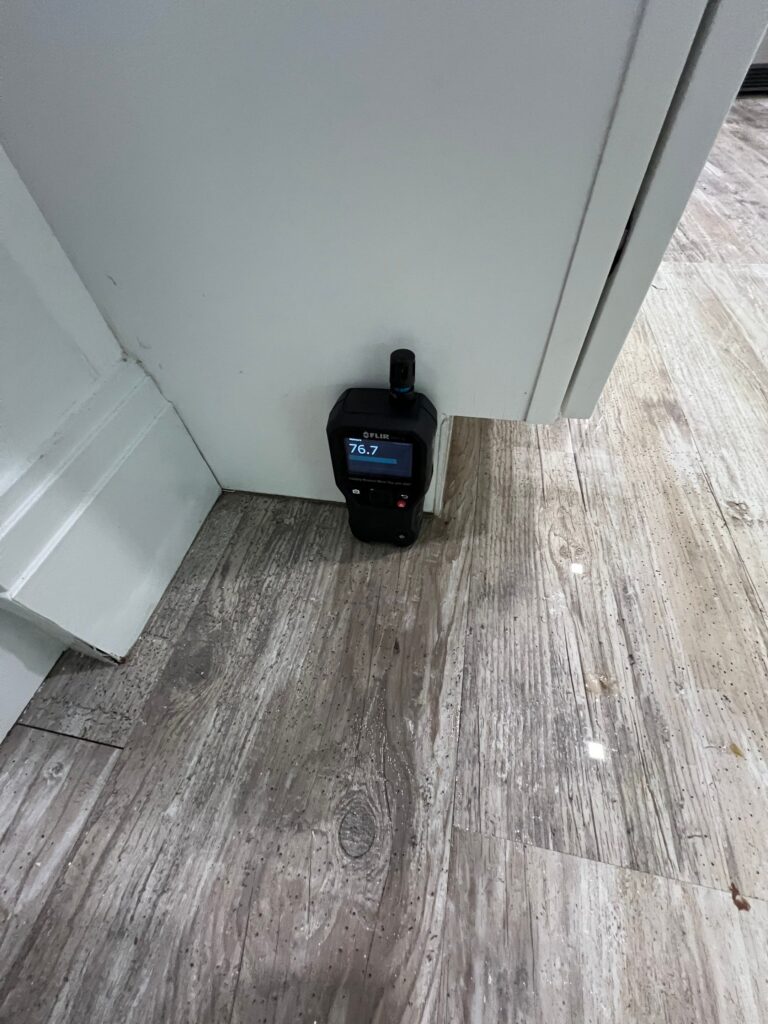
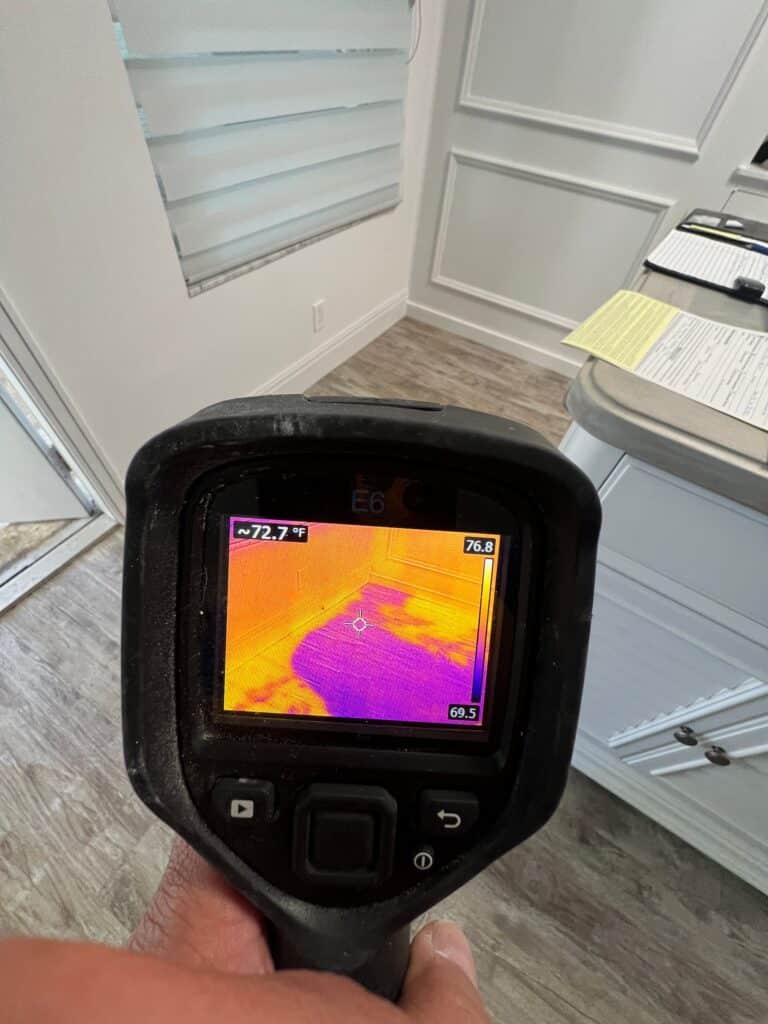
Water trapped beneath laminate flooring may not be immediately visible from above. The flooring can hide moisture while the underlying materials remain wet, allowing deterioration and mold growth to continue.
Prolonged Moisture Resulted in Visible Mold Growth
The amount of time the leak remained active significantly changed the restoration process.
If the dishwasher leak had been discovered immediately, the project may have involved water extraction and conventional structural drying. However, the home had been exposed to moisture for approximately 10 days.
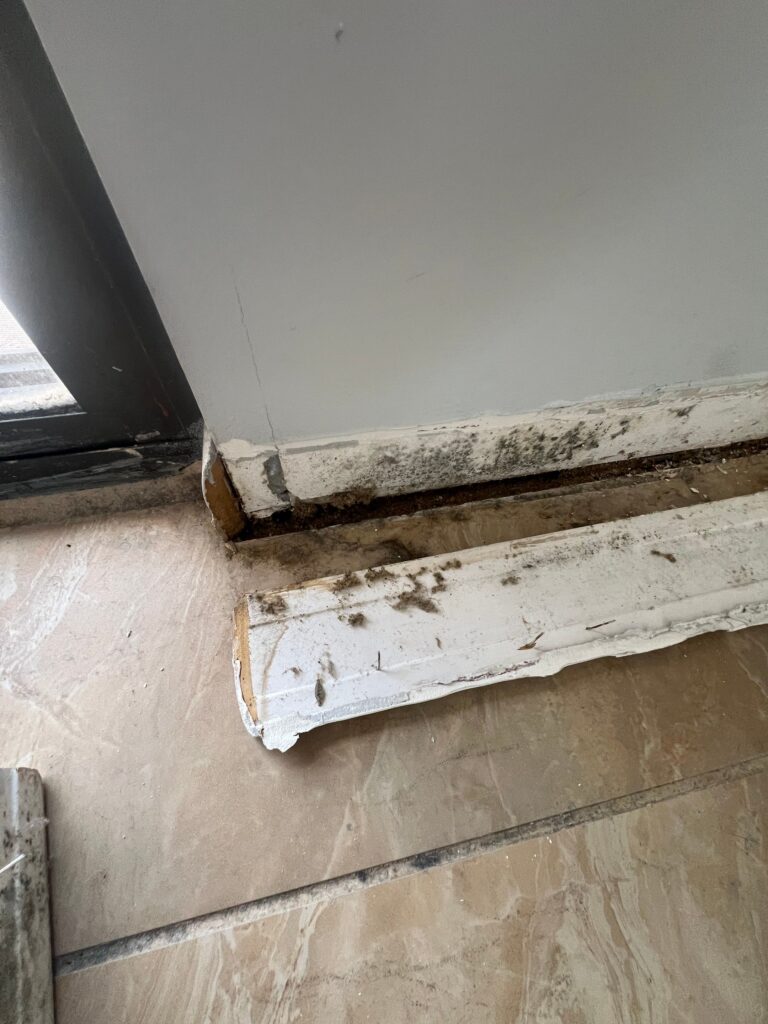
By the time Rescue Clean 911 evaluated the property, visible microbial mold growth had developed within the affected areas.
This meant the project could not be treated as an ordinary clean-water loss. Restoration procedures needed to account for both the remaining moisture and the potential spread of mold contamination.
Why Traditional Air Movers Were Not Used
High-velocity air movers are commonly used during water damage restoration to increase airflow across wet surfaces and encourage evaporation.
However, visible mold was already present inside this property.
Directing high-velocity airflow across mold-contaminated materials could disturb microscopic particles and distribute them into surrounding areas. This could increase the risk of cross-contamination and expose previously unaffected portions of the home.
Because of these conditions, Rescue Clean 911 did not immediately use traditional air movers throughout the affected area.
Knowing when not to use certain restoration equipment is an important part of properly managing a complex water loss.
Using Passive Structural Drying
Rescue Clean 911 used a passive structural drying process to begin reducing moisture inside the home.
Passive drying relies primarily on controlled dehumidification rather than directing aggressive airflow across contaminated surfaces. Commercial dehumidifiers were installed to remove moisture from the indoor air and gradually draw moisture out of affected materials.
This approach allowed the team to begin stabilizing the property while reducing the likelihood that active airflow would spread mold particles throughout the home.
The drying strategy was selected based on the specific conditions present at the property rather than using the same equipment setup applied to every water loss.
Commercial Dehumidification to Control Moisture
Commercial dehumidifiers were placed inside the affected areas to lower indoor humidity and remove moisture from the environment.
As moisture evaporates from wet building materials, it enters the surrounding air. The dehumidification equipment collects this moisture and removes it from the indoor environment.
Controlling humidity was important because elevated moisture can contribute to:
- Continued mold growth
- Swelling and deterioration of building materials
- Warped flooring
- Cabinet damage
- Persistent musty odors
- Additional moisture migration
- Extended drying times
The dehumidifiers operated as part of the five-day mitigation and remediation process.
HEPA Air Scrubbers Helped Control Airborne Particles
Rescue Clean 911 also operated commercial HEPA air scrubbers during the project.
HEPA-filtered air scrubbers are designed to process indoor air and capture very small airborne particles. They are commonly used during mold remediation to help improve air control within and around affected work areas.
The air scrubbers supported the passive drying process by filtering the surrounding air while the dehumidifiers reduced moisture levels.
Together, the equipment helped stabilize the environment without introducing unnecessary high-velocity airflow across visibly contaminated building materials.
Following IICRC S500 and S520 Procedures
This project involved both water damage and mold contamination. Rescue Clean 911 approached the work using principles from the IICRC S500 Standard for Professional Water Damage Restoration and the IICRC S520 Standard for Professional Mold Remediation.
The S500 provides guidance for evaluating and addressing water damage, while the S520 addresses professional mold remediation procedures.
Using both standards was important because the project could not be treated solely as a water extraction job or solely as a mold-removal project. The team needed to account for:
- The original plumbing failure
- Prolonged water exposure
- Moisture beneath continuous flooring
- Visible microbial growth
- The possibility of airborne contamination
- Appropriate drying methods
- Protection of unaffected areas
- Insurance documentation
- Planning for the remaining restoration work
Following the appropriate procedures helped Rescue Clean 911 develop a safer and more effective response for the conditions inside the home.
Knowing What Not to Do During a Mold-Related Water Loss
One of the most important lessons from this project is that equipment commonly used during ordinary water damage restoration may not always be appropriate when mold is present.
Immediately placing high-powered fans throughout a mold-contaminated area could make the situation worse by disturbing spores and distributing them beyond the original damage.
Other actions that may create additional problems include:
- Removing contaminated materials without proper controls
- Walking through affected areas and then entering clean rooms
- Using ordinary household fans
- Attempting to vacuum visible mold with a standard vacuum
- Covering mold with paint or sealants before proper remediation
- Replacing flooring or drywall before moisture is corrected
- Operating contaminated HVAC equipment without evaluation
- Ignoring moisture beneath flooring or cabinets
A professional evaluation helps determine which drying and remediation methods are appropriate for the actual conditions present.
Documenting the Damage for Monarch Insurance
The restoration work was completed as part of an insurance claim with Monarch.
Rescue Clean 911 documented the condition of the home, the known cause of damage, affected materials, visible microbial growth, equipment placement, and the work completed during the project.
Water and mold claims can become complicated when a leak has remained active for an extended period. Documentation helps provide a clearer record of:
- How the loss occurred
- How long the leak may have been active
- Which areas were affected
- Where visible mold was discovered
- Why specific drying methods were selected
- What equipment was used
- What materials required further attention
- How the property was stabilized
Insurance coverage varies by policy, and the carrier determines which portions of the loss are covered. Rescue Clean 911 helps homeowners understand the restoration process while providing documentation related to the completed work.
Completing the Project in Five Days
Rescue Clean 911 completed the water mitigation and mold remediation project over a five-day period.
The project included:
- Evaluating the dishwasher supply line loss
- Identifying water migration beneath the laminate flooring
- Inspecting affected cabinets, baseboards, and building materials
- Documenting visible mold growth
- Developing a restoration plan based on the contaminated conditions
- Avoiding unnecessary high-velocity airflow
- Installing commercial dehumidifiers
- Operating HEPA-filtered air scrubbers
- Monitoring moisture conditions
- Documenting the project for the Monarch insurance claim
- Preparing the home for the remaining restoration process
The carefully selected drying and filtration process allowed Rescue Clean 911 to stabilize the home while reducing the risk of spreading mold contamination.
Hidden Leaks Can Cause Extensive Damage
Slow plumbing leaks are often more damaging than sudden floods because they may remain unnoticed for days or weeks.
Dishwashers, refrigerators, sinks, toilets, washing machines, and water heaters all contain supply lines or connections that can develop hidden leaks.
Warning signs may include:
- Warped or lifting laminate flooring
- Swollen baseboards
- Discoloration near cabinets
- Musty odors
- Dampness beneath appliances
- Soft or deteriorating drywall
- Mold near flooring or walls
- Unexplained increases in indoor humidity
- Water staining inside nearby rooms
- Changes in the sound or operation of an appliance
Homeowners who notice these conditions should stop the water source when possible and have the surrounding materials professionally inspected.
What to Do When Returning Home to Water Damage
Discovering water damage after being away from home can be overwhelming. Homeowners should take several immediate steps when it is safe to do so:
- Shut off the affected fixture or the home’s main water supply.
- Avoid walking through areas where water may have contacted electrical equipment.
- Do not turn on household fans when visible mold is present.
- Avoid disturbing mold-damaged materials.
- Take photographs of the visible conditions.
- Contact a qualified water damage and mold remediation company.
- Notify the insurance carrier after arranging emergency stabilization.
- Keep children, pets, and occupants away from visibly contaminated areas.
The correct response depends on the water source, the length of exposure, the materials affected, and whether mold growth has already occurred.
Flood and Mold Remediation in Wellington
Rescue Clean 911 provides water mitigation, structural drying, mold remediation, HEPA air filtration, and insurance-related restoration services throughout Wellington and the surrounding Palm Beach County area.
The company is a licensed mold remediation contractor and an IICRC-certified water damage restoration firm with experience handling complex losses involving hidden water, prolonged moisture exposure, contaminated building materials, and visible mold growth.
Rescue Clean 911 responds to water and mold damage caused by:
- Dishwasher supply line leaks
- Refrigerator water line failures
- Washing machine leaks
- Burst or leaking pipes
- Water heater failures
- Toilet supply line ruptures
- Air-conditioning drain backups
- Roof leaks
- Plumbing leaks inside walls
- Stormwater intrusion
- Long-term hidden moisture
Homeowners who discover a hidden leak, water beneath flooring, damaged cabinets, musty odors, or visible mold can contact Rescue Clean 911 for a professional evaluation, emergency stabilization, and a restoration plan based on the actual conditions inside the property.
Other Recent Projects
-
HVAC Mold Sanitization in Delray Beach for Three A/C Systems
HVAC Mold Sanitization in Delray Beach for Three A/C Systems Rescue Clean 911 recently completed a two-day HVAC mold sanitization project for a homeowner in the Seven Bridges community of Delray Beach, Florida. Visible microbial growth had developed inside all three air-conditioning systems serving the home, creating concerns about musty odors, indoor air quality, and…
-
Mold Remediation in Boynton Beach After a Roof Leak
Mold Remediation in Boynton Beach After a Roof Leak Rescue Clean 911 recently completed a seven-day mold remediation project for a homeowner in the Valencia Reserve community of Boynton Beach, Florida. The project began after a roof leak allowed moisture to enter the home and affect the surrounding building materials. As moisture remained inside the…
-
Mold Remediation in Wellington After a Refrigerator Supply Line Leak
Mold Remediation in Wellington After a Refrigerator Supply Line Leak Rescue Clean 911 recently completed a seven-day mold remediation project for a homeowner in the Black Diamond community of Wellington, Florida. The damage began when a refrigerator water supply line failed, allowing water to spread from the kitchen into other areas of the home. Although…
-
Airbnb HVAC Duct Cleaning in Wellington After Mold and Musty Odors
Airbnb HVAC Duct Cleaning in Wellington After Mold and Musty Odors Rescue Clean 911 recently completed a one-day HVAC duct cleaning and mold remediation project at an Airbnb property in The Isles community of Wellington, Florida. The property owner had been dealing with persistent musty odors and visible mold contamination inside the air-conditioning system. Because…
-
HVAC Duct Cleaning in Wellington After Mold Was Found in the Air System
HVAC Duct Cleaning in Wellington After Mold Was Found in the Air System Rescue Clean 911 recently completed a scheduled HVAC duct cleaning project for a homeowner in the Grand Isles community of Wellington, Florida. The homeowner had concerns about poor indoor air quality, ongoing respiratory irritation, and contaminants potentially circulating through the home’s air-conditioning…
-
Mold Remediation in Boca Raton After an Upstairs Water Heater Leak
Mold Remediation in Boca Raton After an Upstairs Water Heater Leak Rescue Clean 911 recently completed a planned mold remediation project at a residential property on SE Mizner Boulevard in Boca Raton. The mold growth developed after a ruptured water heater in an upstairs apartment released water into the unit below. The water intrusion affected…